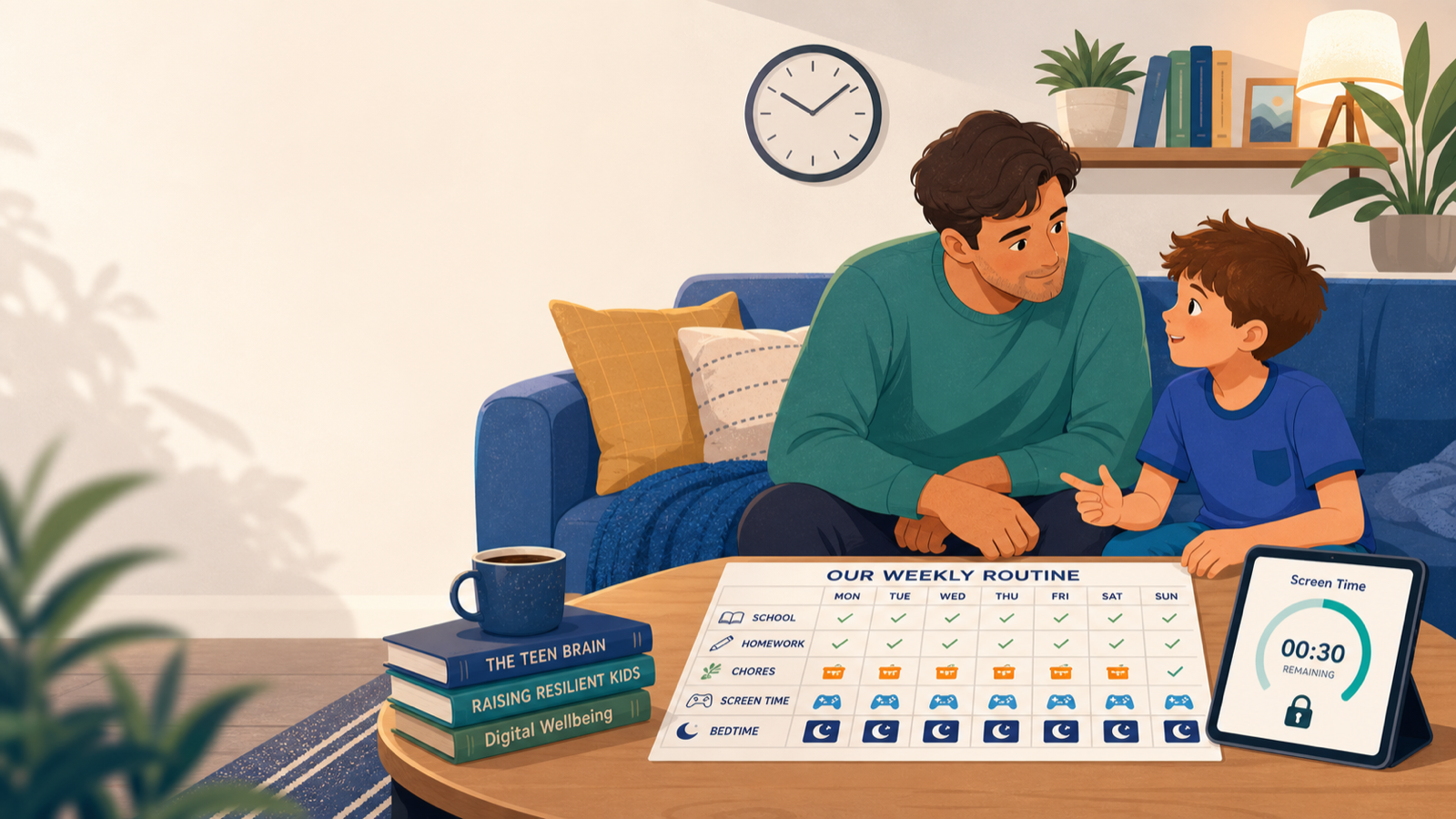
Parents are often told two conflicting messages about screens: either they are harmless, or they are destroying childhood. Neither extreme is very useful when you are trying to run a normal household on a Tuesday night.
The better question is this: what kind of screen use causes problems, and what kind can fit into a healthy routine? Research is more nuanced than most headlines, and that nuance is exactly what helps families make better decisions.
What research generally agrees on
Across many studies and clinical guidelines, one pattern repeats: screen time is most concerning when it displaces the foundations of health and development. Those foundations are sleep, physical activity, face-to-face relationships, school engagement, and emotional regulation.
In other words, the biggest issue is often not a single number of minutes. It is what screen use pushes out of the day. A 2025 study published in PLOS Global Public Health found that screen time predicted disruption across nearly every dimension of sleep — duration, quality, and timing — and that it was the sleep disruption itself, not the screen exposure, that drove harm in adolescents.
That framing is backed up by a large-scale UK study of over 120,000 adolescents by Przybylski and Weinstein (2017), which found that screen time explained less than 1% of wellbeing variance — far less than sleep or eating breakfast. Moderate use was largely neutral. The conclusion: raw minutes are a poor predictor of harm compared to what activities screens displace.
Useful framing: ask "What is being crowded out?" before asking "How many minutes is too many?"
Why hard limits often fail in real homes
Rigid limits look good on paper, but many families struggle to enforce them consistently. Kids push back, parents are tired, schedules vary, and exceptions start stacking up. Once rules feel negotiable, conflict usually increases.
That is why many parents feel trapped between two bad options: constant arguments or giving up on boundaries altogether.
Research suggests that the family environment around screens matters more than the specific limit set. A 2024 study in Acta Paediatrica following more than 10,000 children ages 10–14 found that family conflict was a stronger predictor of screen time than the limits parents tried to set — while consistent, attentive monitoring (rather than strict enforcement) was associated with lower use over time.
If you have read our first post, this will sound familiar: conflict often comes from enforcement design, not just from children "not listening." A rule that depends on repeated parent intervention is fragile under pressure. You can read that breakdown in Why screen time fights happen.
What works better than a single daily number
A more reliable approach combines three layers:
- Non-negotiables: sleep, school responsibilities, and movement come first.
- Predictable boundaries: clear daily/weekly limits and known "off" windows.
- Earning and choice: children can influence outcomes through contribution.
This structure preserves parental boundaries while reducing power struggles. Kids get clarity and agency. Parents get fewer in-the-moment battles. And giving children a genuine say in the rules is not a soft option — a 2024 study in Preventive Medicine Reports found that adolescents involved in setting their own screen time rules did not use screens more than those under strict enforcement, and showed significantly higher prosocial functioning across all age groups.
Good screen rules are less about control and more about predictable trade-offs.
An evidence-aligned weekly setup
If you want a practical starting point, use this framework for two weeks before tweaking:
- Set core no-screen windows: before school, during homework, and during family meals.
- Create a base allowance that fits your child and schedule.
- Allow extra time to be earned through specific chores and responsibilities.
- Use one consistent cutoff at night to protect sleep.
- Review once weekly, not every evening, so rules do not become daily negotiations.
This approach aligns with the updated American Academy of Pediatrics guidelines, which explicitly go "way beyond the amount of time" spent on screens. The AAP's framework emphasises quality, context, and listening to children when establishing limits — not a hard universal number.
What to track instead of just "hours"
Try tracking a few outcomes for 14 days:
- Bedtime resistance and morning mood
- Homework completion without repeated reminders
- Number of screen-related arguments per week
- Whether chores are completed before leisure screens
If those indicators improve, your system is probably moving in the right direction even if total minutes are not perfect yet.
The bottom line
Research does not support panic. It supports structure. Children do best when screens are part of a balanced routine, not the centre of it.
The goal is not to eliminate screens. The goal is to build a home system where important things happen first, and screen use fits around them without daily conflict.
Turn these principles into a routine your family can follow
ScreenRewards helps families connect chores and responsibility to screen access, with consistent enforcement that reduces daily arguments.