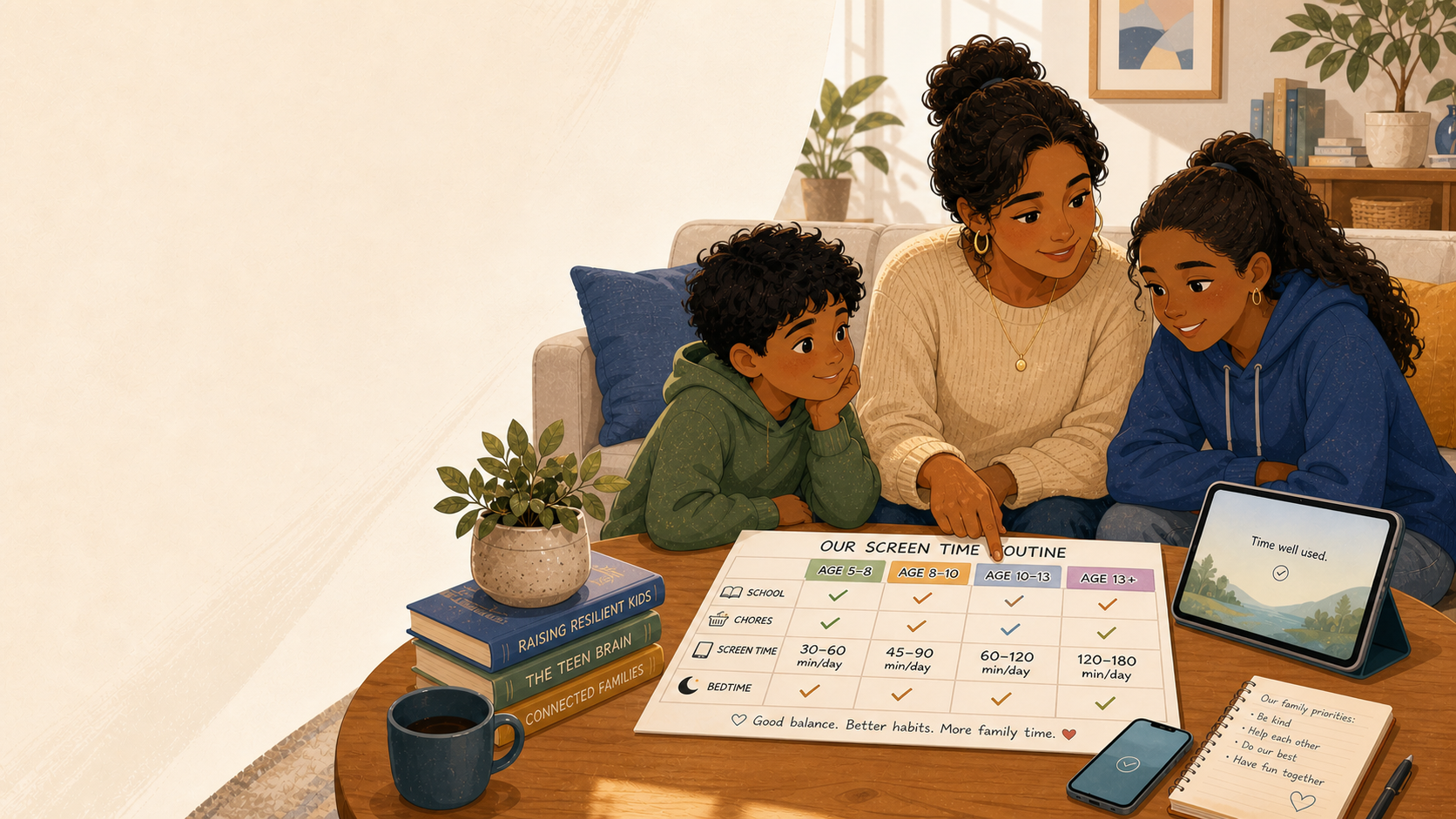
One of the most common questions parents ask is: how much screen time is actually appropriate for my child's age?
It sounds like there should be one clean answer. There is not. A five-year-old, an eight-year-old, a ten-year-old, and a teenager are not dealing with screens in the same way, and family routines differ just as much as children do.
Still, parents need something practical. So this guide is built around a better question than "what exact number is right?" Ask: what level of screen use fits this child's stage of development without crowding out sleep, movement, school responsibilities, and family life?
If you have already read The science behind screen time limits, you will know the big idea: context matters more than raw minutes alone. This guide turns that principle into something you can actually use by age.
Update — May 2026: Since this guide was published, the US Surgeon General released a major advisory on children's screen time, including specific age-based limits. The guidance in this post is consistent with that advisory. We have written a full breakdown of what the advisory says and what it means for families.
Before the age breakdown: what every age group needs
Across the research and clinical guidance, the same foundations come up again and again. Screens become a problem when they displace sleep, physical activity, learning, in-person relationships, and basic household structure.
The American Academy of Pediatrics has moved away from a one-size-fits-all number and now emphasises the quality of media, the context around it, and the way families build routines together. That is a more realistic frame for real homes than chasing a single magic limit.
Simple rule: pick boundaries that protect sleep, school, movement, and family connection first. Then fit screen time around those, not the other way around.
Age 5: keep it simple, visible, and parent-led
At five, most children are not ready to self-manage screens well. They are highly cue-driven, easily dysregulated when something exciting stops suddenly, and still learning how routines work.
For this age, a good setup usually means short, predictable blocks of screen use, ideally at known times of day. Many families do best with something like 30 to 60 minutes on a regular day, usually after key routines are done, rather than scattered access throughout the day.
What matters most is not the exact number. It is whether the routine is obvious. If screen time appears randomly, five-year-olds tend to ask for it constantly. If it happens in a known window, they adapt much faster.
- Prefer short sessions over open-ended use.
- Keep screens out of the hour before bed where possible.
- Choose slow-paced, age-appropriate content over endless-scroll formats.
- Use transitions early: "ten minutes left," then "two minutes left."
Age 8: structure matters more than total minutes
By eight, children usually have more independence but still struggle with stopping when something fun is unfinished. They are old enough to understand rules, but not old enough to manage temptation consistently.
For many families, 45 to 90 minutes of recreational screen time on a school day can work if homework, movement, and bedtime are protected. Weekends are often looser, but still benefit from clear outer boundaries.
This is often the age where daily arguments start. Not because children are impossible, but because they have enough confidence to negotiate and enough screen fluency to care deeply about access. If that is happening in your house, revisit your system before blaming your child. We break that down in Why screen time fights happen.
At eight, consistency beats strictness.
Children this age usually do better with rules like "screens after homework and chores" than with repeated in-the-moment bargaining. A visible routine lowers friction.
Age 10: begin shifting from restriction to responsibility
Ten-year-olds are often in the transition zone. They still need firm boundaries, but they are also ready for more ownership. This is the age where earning systems and simple trade-offs can work especially well.
Many families land somewhere around 60 to 120 minutes of recreational screen time on a typical day, depending on sport, homework load, sleep, and temperament. But again, that number only works if the rest of the day is stable.
At this age, the biggest risk is not only too much time. It is screen time bleeding into everything else because no one is quite sure what comes first. If chores, reading, homework, and family expectations are vague, screens tend to win by default.
- Use screens as part of a routine, not the default filler between activities.
- Make expectations visible: homework first, chores next, leisure screens after.
- Start teaching cause and effect: effort leads to privileges.
- Review rules weekly rather than renegotiating them nightly.
This is also the age where many parents find that earning-based systems reduce conflict. A child can understand, "If I complete my responsibilities, I can unlock more time," and that is often calmer than repeated parent shutdowns.
Age 13+: focus on self-regulation, not just obedience
Once children move into the early teen years, the conversation changes. Screens are no longer just entertainment. They are social life, identity, group chat, gaming, homework, and sometimes conflict with sleep all at once.
That means a simple "one hour a day" rule is often unrealistic and can even backfire if it ignores how teens actually use devices. For many teenagers, the better approach is strong non-negotiables around sleep, school, safety, and device-free times, combined with collaborative limits around leisure use.
A teenager who helps shape the rules is not necessarily getting off easy. Involving them in the system can improve buy-in and reduce pointless power struggles, especially when the expectations are still firm.
- Protect sleep aggressively with a predictable nighttime cutoff.
- Separate school-required device use from recreational use.
- Talk about social pressure, not just "too much screen time."
- Track mood, sleep, and conflict, not only hours.
How to tell if your current level is too high
Instead of obsessing over a single number, look for functional signs that the balance is off:
- Bedtime keeps blowing out because screens are hard to stop.
- Homework, chores, or morning routines become a fight every day.
- Your child cannot tolerate boredom without reaching for a device.
- Screen-related conflict is consuming family energy.
- Physical activity, hobbies, or in-person play are shrinking.
If those signs are present, the answer is usually not just "cut everything." It is to improve the structure around screens so limits stop depending on constant parent intervention.
A practical starting point for families
If you want to reset without overcomplicating things, try this for two weeks:
- Choose one clear school-night limit and one clear weekend limit.
- Keep devices out of meals, homework time, and the pre-bed routine.
- Make chores and responsibilities happen before recreational screens.
- Review the system weekly using sleep, mood, and conflict as your scorecard.
That last part matters. The best screen time plan is the one your family can apply consistently.
The bottom line
Appropriate screen time changes with age, but healthy screen use always depends on the same foundations: sleep, movement, relationships, school, and a household routine that does not collapse the moment a screen is involved.
For younger children, lean harder on structure and predictability. For older children, shift gradually toward responsibility and self-regulation. Across all ages, the goal is not perfect control. It is a system that keeps screens in their place.
Need a screen routine that is easier to enforce?
ScreenRewards helps parents connect chores and responsibility to screen access, so the rules feel clearer and the fights happen less often.